
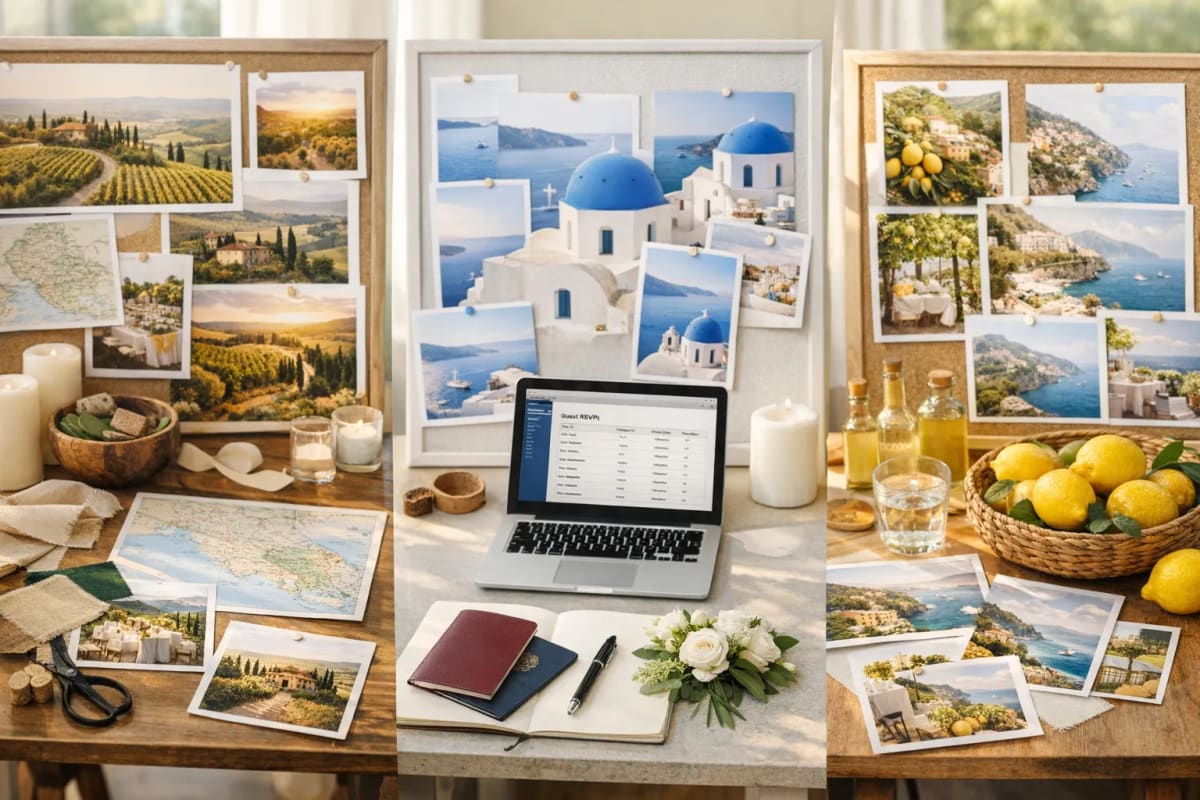
Introduction
Compare Tuscany, Santorini and the Amalfi Coast for a wedding by scenery, costs, planning ease and guest experience, so you can choose wisely.
Choose the place that makes the whole weekend workable, not only the ceremony photo. The prettiest cliff can still be the hardest place to host 80 guests.
The short answer: Tuscany is usually the best all-rounder for a wedding, Santorini is the strongest choice for a smaller, ultra-scenic celebration, and the Amalfi Coast is the most dramatic but often the most logistical. If your guest list is large, mixed-age, or coming from the US, UK and India, Tuscany is usually the easiest place to host well without making guests feel squeezed.
Which destination gives you the best balance for a wedding?
Tuscany wins on flexibility, Santorini wins on visual impact, and the Amalfi Coast wins on romance with a caveat: you will pay for the setting with harder logistics. That is the real decision, not just which place looks best on Instagram.
Here is the cleanest way to think about the three:
| Destination | Best for | Planning ease | Guest comfort | Trade-off |
|---|---|---|---|---|
| Tuscany | Larger weddings, multi-event weekends, food-and-wine couples | Easier | Strong | Less dramatic sea views |
| Santorini | Intimate weddings, elopements, sunset ceremonies | Moderate to hard | Mixed | Limited space and steeper access in some areas |
| Amalfi Coast | Chic, smaller weddings with a luxury feel | Hardest | Mixed | Traffic, stairs and higher vendor pressure |
If you want one destination that can handle a ceremony, dinner, welcome event and after-party with less stress, Tuscany is the practical choice. If your priority is a dramatic ceremony backdrop and you can keep the guest count tighter, Santorini or the Amalfi Coast can be worth the extra effort.
What does each place actually feel like for guests?
The guest experience is very different in these three locations, and that affects how much your wedding feels like a celebration versus a travel assignment.
Tuscany feels spacious and relaxed
Tuscany usually gives you room to spread out, especially at villas, estates and countryside venues. Guests are more likely to have easier transfers, more hotel choices and a calmer pace between events.
For couples hosting Indian, Muslim or fusion weddings with several functions, this matters a lot. A place that can handle a mehndi, sangeet, welcome dinner and wedding day without constant venue changes makes the whole weekend less tiring.
Santorini feels spectacular but narrow in scope
Santorini is ideal if you want a very focused wedding: ceremony, portraits, dinner, maybe a small celebration after. Many venues are best suited to smaller guest counts, and the island's dramatic terrain can be tough for older relatives or anyone with mobility issues.
That does not make it a bad choice. It just means Santorini works best when you are already comfortable trimming the guest list and simplifying the format.
The Amalfi Coast feels glamorous and a little demanding
The Amalfi Coast has the most cinematic sea-and-cliff feel of the three, but it can be the most demanding for guests and vendors. Roads can be slow, parking is limited in some areas, and getting everyone to the right place at the right time takes discipline.
That is fine if you want a polished, destination-style celebration with a smaller guest list. It is less ideal if your family expects easy movement, lots of room, or multiple large functions.
How much budget pressure should you expect?
No one should choose a wedding destination based on scenery alone, because the setting changes your budget in practical ways. Venue exclusivity, transport, accommodation choices and guest count usually matter more than the country itself.
As a rule, Tuscany often gives you the most options across mid-range and premium budgets. Santorini and the Amalfi Coast typically push costs up because iconic views come with tighter availability and more competition for the best dates. Costs vary widely by city, season and vendor, so treat any range as a planning band rather than a promise.
The hidden budget drivers are usually these:
- guest transport between airport, hotel and venue
- hotel minimum stays during peak season
- staging, lighting and rentals for outdoor events
- backup plans for wind, heat or rain
- extra coordination time for local vendors and translators if needed
If you are comparing quotes, ask each venue what is included in the site fee, what happens if weather changes the setup, and whether there are restrictions on music or timing. Those details often decide the true cost more than the headline venue price.
Which one is easiest for a wedding-planning timeline?
Tuscany is generally the easiest to plan well, especially if you want a more layered weekend. Santorini and the Amalfi Coast both reward couples who book early and keep decisions simple.
A useful planning rule is this: the more scenic and compact the destination, the earlier you should secure venue, accommodation and transport. In the highest-demand months, the best properties disappear first and the backups may not match your style or guest needs.
For a destination wedding, I would plan it like this:
- 12 to 18 months out: choose destination, hold the venue, confirm guest count assumptions
- 9 to 12 months out: book key accommodation blocks and transport plan
- 6 to 9 months out: lock styling, menu and event schedule
- 3 to 6 months out: send detailed guest information, travel notes and RSVP reminders
That final step matters more than couples expect. Guests need clear directions, timing, dress-code guidance and a single place to check event details. A wedding website helps here, especially if you are hosting multiple events across Europe and want one shareable link for the story, schedule, maps and RSVPs. If that is useful, start with DreamWedds free wedding website.
A worked example: 120 guests across three events
Say you have 120 guests, and you want a welcome dinner, wedding ceremony and reception over three days.
In Tuscany, that format is realistic if you choose a villa or estate with room for movement, parking and meal service. You can keep grandparents comfortable, give children space, and reduce the need for multiple venue transfers. The trade-off is that you may sacrifice the cliffside drama many couples picture first.
In Santorini, the same guest count becomes much harder unless you are using a larger venue and a very disciplined event schedule. The destination is beautiful, but the logistics of seating, timing and access can become the story of the weekend if you do not scale back.
On the Amalfi Coast, 120 guests is possible, but you should expect tighter coordination and a stronger need for a planner who knows the area. This is the option for couples who want a high-style event and are willing to accept more moving parts.
My opinion: if your guest list is above about 80 and you want more than one celebration, Tuscany is usually the smartest pick. Santorini and the Amalfi Coast are better when you want to keep things intimate and visually concentrated.
Which destination suits your couple type best?
The best destination depends on the kind of wedding you are actually hosting.
Choose Tuscany if you want:
- a comfortable guest experience
- a multi-day wedding with several functions
- more venue variety
- easier room for family members of different ages
Choose Santorini if you want:
- a smaller ceremony with a strong visual payoff
- sunset portraits as a priority
- a shorter, simpler event schedule
- a guest list that is already naturally intimate
Choose the Amalfi Coast if you want:
- a polished coastal feel with a luxury edge
- a wedding that feels like a mini escape
- strong design impact in a compact setting
- a planner-led experience where details are tightly controlled
For many couples, the right answer is not the place that looks most famous. It is the place that fits the rhythm of your wedding, your family and your budget.
What couples usually get wrong here
The biggest mistake is choosing the destination before choosing the guest experience. People fall in love with the view, then discover the venue cannot comfortably handle the wedding they want.
The second mistake is underestimating travel fatigue. Guests remember stairs, transfers, check-in times and unclear instructions far more than linen colour. The third is assuming every scenic venue has enough rain or wind backup to make outdoor plans stress-free.
A better approach is to decide three things first: how many guests you want, how many events you want, and how much movement your family can realistically manage. Once those are set, the destination choice becomes much clearer.
What should you do next?
Start with your guest count and event count, then shortlist the destination that fits both. If you need one place to share travel details, event timings, maps and RSVPs, set up a wedding website early so guests are not piecing everything together from messages.
If you are planning a multi-day or cross-cultural wedding, look at a site structure built for several events rather than a single ceremony page. That saves time for you and makes the trip easier for your guests.
Frequently asked questions
Is Tuscany better than Santorini for a wedding with older guests?
Usually yes. Tuscany often offers easier access, more transport options and larger venues with fewer steep routes. Santorini can still work, but it is better suited to guests who are comfortable with stairs, uneven paths and shorter event schedules.
Can you host a multi-day wedding on the Amalfi Coast?
Yes, but the planning needs to be tight. The Amalfi Coast works best when your events are close together, your guest list is controlled and you are prepared for traffic and transfer timing. Without that structure, the logistics can become stressful.
Which destination is best for a small wedding of under 40 guests?
Santorini is often the strongest choice for a very small wedding because the setting feels intimate and visually powerful. Tuscany is also excellent if you want room to spread out over several events. The better pick depends on whether you want sea views or a countryside atmosphere.
Do you need a planner for these destinations?
You can plan them without one, but local expertise helps a lot, especially for the Amalfi Coast and Santorini. A planner can manage timing, vendor communication and site logistics, which becomes more valuable as your guest list grows or your schedule includes multiple events.

How to Create and Send an RSVP Link for Your Wedding (Step-by-Step)
8 NOV 2026
Tuscany vs Santorini vs Amalfi Coast for a wedding
18 JUN 2026

How Much Does a Destination Wedding in Europe Cost?
18 JUN 2026
Top 20 Wedding Destinations in Europe for a Fairytale Wedding
18 JUN 2026

Wedding Checklist for US Couples: What to Do and When
18 JUN 2026

Best Wedding Venues in the USA for Every Budget
18 JUN 2026
20 Most Popular Wedding Themes in America for 2026
18 JUN 2026

Average Wedding Cost in the USA: 2026 Budget Breakdown
18 JUN 2026

The Complete Wedding Planning Timeline for Busy Couples
18 JUN 2026
35 Unique Wedding Ideas That Wow Your Guests
18 JUN 2026
How to Create and Send an RSVP Link for Your Wedding (Step-by-Step)
8 NOV 2026
Tuscany vs Santorini vs Amalfi Coast for a wedding
18 JUN 2026
How Much Does a Destination Wedding in Europe Cost?
18 JUN 2026
Top 20 Wedding Destinations in Europe for a Fairytale Wedding
18 JUN 2026
Wedding Checklist for US Couples: What to Do and When
18 JUN 2026
Best Wedding Venues in the USA for Every Budget
18 JUN 2026
20 Most Popular Wedding Themes in America for 2026
18 JUN 2026
Average Wedding Cost in the USA: 2026 Budget Breakdown
18 JUN 2026
The Complete Wedding Planning Timeline for Busy Couples
18 JUN 2026
35 Unique Wedding Ideas That Wow Your Guests
18 JUN 2026
