

Introduction
Plan a wedding in Europe with 20 stunning destinations, plus practical notes on weather, guest travel, paperwork and the right fit for your celebration.
Pick the place that fits your guest list and ceremony style first. The prettiest backdrop is useless if your paperwork, weather window or travel plan is a mess.
Which European wedding destination fits your celebration best?
The best wedding destination in Europe is the one that matches your guest count, ceremony style, and paperwork tolerance. If you want my honest take, choose the setting after you decide how many events you’re hosting, because a single sunset ceremony has very different logistics from a three-day celebration.
A European wedding usually works best when couples sort destinations into three buckets: classic romance, guest-friendly city access, and low-key countryside charm. That gives you a smarter shortlist than simply chasing the prettiest photos.
The 20 European wedding destinations that actually deliver
These wedding destinations in Europe stand out because they combine strong scenery with a clear event style, so you can match the place to the celebration.
1) Amalfi Coast, Italy
This is the obvious choice for couples who want cliffside drama, lemon groves, and a luxurious feel. It suits smaller guest lists, especially if you want one main ceremony and one elegant dinner rather than a packed multi-venue schedule.
2) Lake Como, Italy
Lake Como works for couples who want polished, cinematic glamour without a beach wedding feel. Villas here are often best for formal celebrations and couples who care about arrival photos almost as much as the ceremony itself.
3) Tuscany, Italy
Tuscany is the safest pick for a warm, rustic wedding with vineyards, olive trees, and countryside estates. It is a good fit if you want multiple events in one property, because guests can stay put and the pace feels relaxed.
4) Positano, Italy
Positano is for couples who want vertical, colourful, high-impact scenery and do not mind tight streets or steep climbs. It looks gorgeous in photos, but it works best if you keep the guest list focused and the logistics simple.
5) Santorini, Greece
Santorini is ideal for a sunset ceremony with volcanic views and whitewashed architecture. The trade-off is crowds in peak season, so it suits couples who are comfortable planning around timing and tourism.
6) Mykonos, Greece
Mykonos is better for a lively, stylish celebration than a quiet, traditional one. It suits couples who want a destination wedding with excellent beach clubs, strong nightlife, and a guest experience that feels celebratory all weekend.
7) Crete, Greece
Crete gives you more space, variety, and flexibility than many smaller Greek islands. It works well for couples who want beaches, village charm, and the option to host guests over several days without the island feeling too polished or too crowded.
8) Dubrovnik, Croatia
Dubrovnik is a strong choice if you want old-world stone walls, sea views, and a compact city that is easy for guests to understand. It is especially good for couples who want a destination wedding that still feels walkable.
9) Hvar, Croatia
Hvar has a chic island feel with clear water and a social summer atmosphere. It is best for couples who want a stylish Mediterranean wedding and are comfortable planning around seasonal demand.
10) Montenegro coast
Montenegro is one of the most underrated wedding destinations in Europe because you can get dramatic coastline without the same level of saturation as better-known spots. It suits couples looking for value, scenery, and a slightly less predictable guest experience.
11) Lisbon, Portugal
Lisbon is a smart choice for couples who want city energy, tiled backdrops, and easy access to wine country nearby. It works well if you want a wedding that feels cultural and lively rather than purely resort-based.
12) Sintra, Portugal
Sintra is perfect for a fairy-tale feel with palaces, gardens, and a more whimsical setting than a beach town. It suits couples who want a romantic, almost storybook atmosphere for their ceremony and portraits.
13) Douro Valley, Portugal
Douro Valley is best for wine-loving couples who want landscapes, terraces, and a slower pace. It is especially strong for multi-day weddings because the region naturally supports long, lingering meals and tastings.
14) Paris, France
Paris is the right pick if your idea of romance is urban, refined, and timeless. It is a good choice for smaller weddings or symbolic ceremonies, with easy guest recognition and plenty of elegant reception options.
15) Provence, France
Provence works for couples who want lavender fields, stone farmhouses, and a soft summer palette. It suits an intimate wedding well, especially if you want a relaxed meal-driven celebration rather than a high-production party.
16) Bordeaux, France
Bordeaux is a strong option for couples who want vineyards and a more structured wine-region feel. It pairs well with formal dinners and guest itineraries that include tastings and countryside stays.
17) Edinburgh, Scotland
Edinburgh is one of the best wedding destinations in Europe for couples who want atmosphere, history, and easy city logistics. It suits both intimate weddings and larger guest lists because there is a wide range of venues.
18) Scottish Highlands, Scotland
The Highlands are for couples who want moody landscapes, castle settings, and a wedding that feels remote in the best way. The trade-off is weather flexibility, so this is for couples who can roll with a little unpredictability.
19) Swiss Alps, Switzerland
The Swiss Alps are best for couples who want clean, dramatic scenery and a crisp mountain aesthetic. It suits winter weddings especially well, though summer mountain celebrations can be equally strong if you want outdoor views.
20) Vienna, Austria
Vienna is a refined choice for couples who want grand architecture, music, and a formal atmosphere. It works beautifully for classic, elegant weddings where guests can enjoy a city break as part of the celebration.
How do you choose the right European destination without overthinking it?
Choose the destination that fits your wedding format first, then your aesthetic. That means deciding whether you want a one-day ceremony, a two-event weekend, or a full multi-day wedding before you fall in love with a location.
Here is the simplest decision rule:
| If your priority is | Best destination types |
|---|---|
| Intimate, high-end scenery | Lake Como, Santorini, Positano |
| Multi-day guest experience | Tuscany, Crete, Douro Valley |
| Easy city travel | Paris, Lisbon, Edinburgh, Vienna |
| Storybook atmosphere | Sintra, Provence, Scottish Highlands |
| Stylish party energy | Mykonos, Hvar, Amalfi Coast |
My opinion: if you have a mixed guest list with older relatives and friends flying in from different countries, choose a city or well-connected region over a remote island. The better the transport, the fewer stressed guests you will have on arrival day.
What couples get wrong about a European wedding
The most common mistake is choosing the venue before checking the legal and practical requirements. Ceremony legality, residency rules, religious requirements, and document timelines vary by country and sometimes by region, so confirm everything with the official authority for your destination before you book gov.uk or the relevant embassy or local civil registry.
The second mistake is underestimating guest movement. A dreamy cliffside venue can become exhausting if guests need multiple cars, ferries, or steep walks between events.
The third mistake is treating weather as a background detail. In Europe, a location can be perfect in May and inconvenient in August or October, depending on the region.
A worked example for a 120-guest wedding
Say you have 120 guests across three events: a welcome dinner, the ceremony and reception, and a farewell brunch. If half your guests are travelling from the US and UK, a destination like Tuscany, Lisbon, or Edinburgh is usually easier to manage than a remote island because flights, transfers, and hotel blocks are simpler to coordinate.
In that case, you might choose Tuscany if you want a villa with space for all three events in one place, or Edinburgh if you want better city transport and a wide range of hotels at different budgets. Santorini would still be possible, but you would need tighter guest planning, earlier bookings, and a clearer backup plan for transport and timing.
Small choices that make the whole wedding easier
A clear website and RSVP system save you from a thousand scattered messages. If you are managing multiple events, venue addresses, maps, dress codes, and reminders, one shared link is far more useful than a long email thread. DreamWedds free wedding website is built for couples who want to keep the schedule, locations, and guest responses in one place.
A few other practical moves help a lot:
- Book venues with one weather backup option, not just a pretty plan A.
- Send travel guidance by event, not in one giant paragraph.
- Keep the welcome dinner simpler than the reception.
- Share local transport details before guests start asking individually.
The next three steps
Start by narrowing your list to three destinations based on guest travel, ceremony style, and season. Then compare venue access, paperwork, and the number of events you want to host.
After that, build your guest communication plan early. If your wedding has multiple events, one website with RSVPs, venues, and reminders makes the whole process easier for you and far clearer for guests.
Frequently asked questions
What is the easiest European country for a destination wedding?
The easiest country depends on your ceremony type and paperwork, but cities with strong international access usually make planning simpler for guests. Couples often find major hubs easier than remote islands because transport, hotel options, and vendor availability are more straightforward. Always confirm legal steps with the official local authority.
Should I choose a beach, city, or countryside wedding in Europe?
Choose based on guest comfort and the kind of weekend you want. Beaches feel relaxed, cities are practical, and countryside settings are best for slower, more immersive celebrations. If your guest list includes older relatives or a lot of long-haul travellers, a city or well-connected region usually wins.
What month is best for a wedding in Europe?
There is no single best month across Europe because climate varies widely by country and coast. Late spring and early autumn are often popular because temperatures are milder and crowds can be lighter than peak summer, but the right choice depends on the exact destination.
Do I need a wedding planner for a European wedding?
You do not always need a full-service planner, but you do need someone to own logistics if the wedding is outside your home country. That might be a planner, venue coordinator, or a trusted local supplier. At minimum, assign one person to handle timing, transport, and guest communication.

How to Create and Send an RSVP Link for Your Wedding (Step-by-Step)
8 NOV 2026
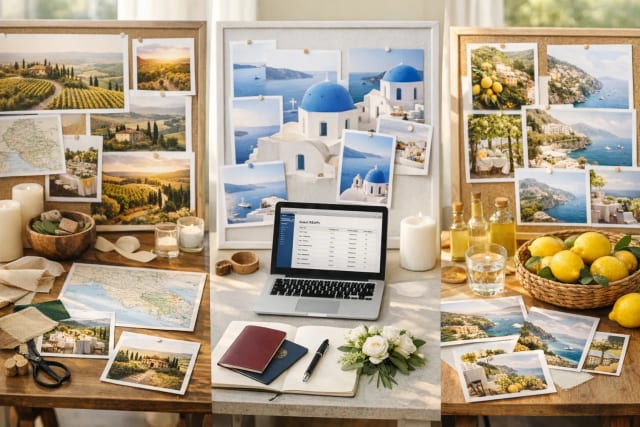
Tuscany vs Santorini vs Amalfi Coast for a wedding
18 JUN 2026

How Much Does a Destination Wedding in Europe Cost?
18 JUN 2026

Top 20 Wedding Destinations in Europe for a Fairytale Wedding
18 JUN 2026

Wedding Checklist for US Couples: What to Do and When
18 JUN 2026

Best Wedding Venues in the USA for Every Budget
18 JUN 2026
20 Most Popular Wedding Themes in America for 2026
18 JUN 2026

Average Wedding Cost in the USA: 2026 Budget Breakdown
18 JUN 2026

The Complete Wedding Planning Timeline for Busy Couples
18 JUN 2026
35 Unique Wedding Ideas That Wow Your Guests
18 JUN 2026
How to Create and Send an RSVP Link for Your Wedding (Step-by-Step)
8 NOV 2026
Tuscany vs Santorini vs Amalfi Coast for a wedding
18 JUN 2026
How Much Does a Destination Wedding in Europe Cost?
18 JUN 2026
Top 20 Wedding Destinations in Europe for a Fairytale Wedding
18 JUN 2026
Wedding Checklist for US Couples: What to Do and When
18 JUN 2026
Best Wedding Venues in the USA for Every Budget
18 JUN 2026
20 Most Popular Wedding Themes in America for 2026
18 JUN 2026
Average Wedding Cost in the USA: 2026 Budget Breakdown
18 JUN 2026
The Complete Wedding Planning Timeline for Busy Couples
18 JUN 2026
35 Unique Wedding Ideas That Wow Your Guests
18 JUN 2026
