

Introduction
This wedding planning timeline breaks the process into clear monthly steps so busy couples know what to book, confirm and finalise right up to the wedding.
A good wedding timeline is not about doing everything early. It is about locking the right decisions early and leaving the rest flexible.
The fastest way to reduce wedding stress is to stop treating planning like one giant project and turn it into monthly decisions. Focus first on the few choices that control everything else: date, venue, guest count, and vendors with limited availability.
If you are busy, the right wedding planning timeline is less about doing more and more about booking in the correct order. That order is what keeps you from paying rush fees, double-booking yourself, or making decoration choices before you know how many people are actually coming.
How far in advance should you start wedding planning?
Start 12 to 18 months ahead if you want the most choice for venues and key vendors, and 9 to 12 months ahead if you are flexible on date, location, and style. If you have a shorter runway, you can still plan a good wedding, but you will need faster decisions and fewer custom details.
The honest trade-off is this: the longer timeline gives you more options, while the shorter timeline gives you less decision fatigue. Busy couples often do better with fewer choices, not more.
What should you book first in a wedding planning timeline?
Book the venue first, then the key vendors who depend on that date. Those usually include the planner or coordinator, photographer, caterer, officiant or celebrant, and entertainment if your venue requires outside vendors to be approved.
After that, lock the guest list estimate. Your guest count affects food, invitations, transport, seating, and even the size of your wedding website or RSVP form. A rough number is enough early on, but do not leave it vague for too long.
12 to 18 months before: set the foundations
This is the stage for the decisions that shape everything else. Choose your wedding date range, decide your likely guest count, and book the venue if you have not already done so.
Your checklist
- Agree on budget priorities: what matters most, what can be simple, what you will skip
- Decide ceremony style, legal requirements, and whether you need separate civil and religious steps
- Shortlist venues that fit your guest count and event style
- Book the venue and any major vendors with limited availability
- Create a shared planning system for tasks, documents, and deadlines
For multi-event celebrations, this is also the time to map the whole flow. If you are planning mehndi, sangeet, haldi, nikah, walima, reception, or another combination, decide which events are essential and which are optional. That keeps the wedding planning timeline realistic instead of overloaded.
9 to 12 months before: lock the big decisions
This is when your wedding starts becoming real on paper. Book photography, catering, music, attire, and any transport that needs to match your timeline or venue logistics.
This is also a good time to begin your guest communication system. If you are managing multiple events or a mixed guest list across cities or countries, a wedding website helps keep the story, schedule, venue details, and maps in one place. DreamWedds is built for that kind of multi-event setup, especially for South Asian, Muslim, destination, and fusion weddings. If you want one place to share event details and collect RSVPs, start here: DreamWedds free wedding website.
What to finalise now
- Photographer and videographer style and deliverables
- Caterer menu direction, dietary notes, and service style
- Entertainment, emcee, DJ, or live performers
- Dress shopping or tailoring timeline
- Ceremony format and order of events
- Guest list draft for save-the-dates or early notice
6 to 9 months before: turn plans into bookings and drafts
This is the phase where you move from “we have ideas” to “we have a plan.” Order stationery, draft your website wording, build your RSVP list, and start collecting missing addresses.
If your wedding has multiple events, build the calendar now rather than later. Put each event on its own line with time, venue, dress code, and parking or transport notes. That stops guests from confusing the haldi with the reception or turning up late because they did not realise the venue changed.
A useful decision rule
If a choice affects logistics, make it now. If a choice affects aesthetics only, it can wait a little longer.
That means things like venue flow, travel, meal service, and guest transport come before tiny decor details. Chair ribbons can wait. Timing cannot.
3 to 6 months before: narrow the moving parts
This is when most busy couples benefit from a strict monthly wedding planning timeline. Confirm guest counts, finalise attire fittings, and make sure every vendor has the latest schedule and contact details.
Your checklist
- Send save-the-dates if you have not already
- Confirm ceremony and reception timings with the venue
- Finalise menu tasting decisions and dietary requests
- Book hair and makeup trials if needed
- Choose ceremony readings, music cues, and speeches
- Review transport, hotel blocks, or parking notes
- Keep RSVP tracking current
If you are using a wedding website with RSVP management, update it as soon as a venue time or event location changes. That small habit saves you from sending repeated messages to the whole guest list.
8 to 12 weeks before: decide the details guests will feel
This is the point where the guest experience becomes visible. Finalise your seating approach, print needs, ceremony script, and the exact order of events for every function.
You also want to check the practical pieces that get missed when couples are busy: who is collecting vendor deliveries, who holds the emergency kit, and who is in charge of cueing the processional. Give each job to a specific person.
Common mistake to avoid
Do not leave RSVPs until the last minute because you think everyone will reply quickly. They usually do not. Build in a buffer so you can follow up without scrambling.
4 to 6 weeks before: confirm, chase, and cut decisions
This is the month to get firm numbers. Confirm vendor arrival times, menu counts, table plans, ceremony participants, and the final guest list.
Final confirmations
- Venue final walkthrough or coordination call
- Final catering count and dietary list
- Final transportation schedule
- Final attire fitting and accessories check
- Final ceremony and reception run sheet
- Final guest reminders for travel, dress code, and timing
If you are planning a South Asian or Muslim wedding with several events, this is also the stage to double-check which guests are invited to which event. A single shared invitation message can easily create confusion unless your event structure is clearly laid out.
2 weeks before: stop planning and start coordinating
At this point, you are not redesigning anything. You are checking logistics, sharing the final schedule, and making sure the right people have the right information.
Print or save copies of vendor contacts, timelines, table plans, and any legal or ceremonial documents you need on the day. Confirm who is paying each vendor, who signs off on changes, and who keeps the day moving if you are both occupied.
What to send out
- Final schedule to the wedding party and key family members
- Venue directions and parking notes
- Hotel and transport reminders for out-of-town guests
- Reminder messages for any guests who have not RSVP’d
Final week: protect your time and energy
The final week is for packing, reconfirming, and resting. Avoid making new decisions unless something truly affects the schedule or safety.
Pack these early
- Outfits and backup items
- Rings, documents, vows, and ceremony notes
- Power banks, chargers, medicines, and touch-up items
- Vendor payments, tips, and envelopes if needed
- Event-specific items for multi-day weddings
If you are running a wedding website, this is a smart time to send one last reminder with the event order, map links, and any last-minute changes. That is especially useful for guests juggling multiple venues or travel plans.
Say you have 120 guests across three events
Say you have 120 guests across a mehndi on Friday, ceremony on Saturday, and reception on Sunday. Your timeline should prioritise venue and catering first, because those decisions affect all three events, then photography and transport, then outfits and decor.
In that setup, a good month-by-month plan would look like this: book the venue and caterer 12 months out, confirm photography and entertainment by 9 months, open RSVPs and guest list tracking by 6 months, finalise headcounts by 4 to 6 weeks, and send event-specific reminders in the final two weeks.
That sequence works better than trying to finish one event at a time, because the guest flow, travel needs, and vendor timing are connected.
What busy couples should do differently
Busy couples should simplify early, batch decisions, and use one source of truth for guest information. The biggest mistake is trying to manage everything through scattered texts and saved notes.
Use one shared checklist, one calendar, and one place for guests to find the latest details. If your wedding has multiple events or a guest list spread across cities, a wedding website can cut down repeat questions and make RSVP tracking cleaner. DreamWedds is useful for that exact job because it lets couples share every event, venues, maps, guest list details, and WhatsApp reminders in one link.
Your next three moves
Pick your date range, lock the venue, and build your guest list estimate this week. Then decide how you will track RSVPs and event updates so you are not chasing people across multiple apps.
If a wedding website would make guest communication easier, set it up early and keep it updated as details change. That is one of the few planning tools that genuinely saves time.
Frequently asked questions
When should I send save-the-dates?
Send save-the-dates around 8 to 12 months before the wedding if guests need to travel, take time off work, or plan childcare. For local weddings with simpler logistics, you can send them a little later. If your event has multiple functions, include enough context so guests know what they are being invited to and when.
How long before the wedding should RSVPs be due?
A common working window is 4 to 6 weeks before the wedding, earlier if you need to give final numbers to a caterer or transport provider. Set the deadline with your own vendor cut-offs in mind. Leave yourself at least a few days to follow up with people who have not replied.
What if we are planning a wedding in less than 6 months?
Prioritise venue, guest count, and vendors with the hardest-to-find availability. Choose ready-made solutions where possible and keep decor simple. Short timelines can work well if you make decisions quickly and avoid changing your mind every few weeks. The trade-off is less customisation.
Should we plan everything ourselves or hire help?
If you have limited time, a coordinator or planner can reduce stress, especially for multi-event weddings or complex logistics. If your budget is tighter, focus on systems that keep you organised and reduce admin. A shared planning calendar and clear guest communication can cover a lot of ground.
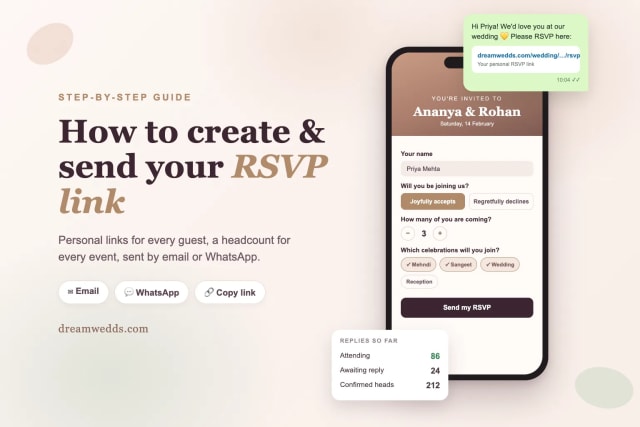
How to Create and Send an RSVP Link for Your Wedding (Step-by-Step)
8 NOV 2026
Tuscany vs Santorini vs Amalfi Coast for a wedding
18 JUN 2026

How Much Does a Destination Wedding in Europe Cost?
18 JUN 2026

Top 20 Wedding Destinations in Europe for a Fairytale Wedding
18 JUN 2026

Wedding Checklist for US Couples: What to Do and When
18 JUN 2026

Best Wedding Venues in the USA for Every Budget
18 JUN 2026

20 Most Popular Wedding Themes in America for 2026
18 JUN 2026

Average Wedding Cost in the USA: 2026 Budget Breakdown
18 JUN 2026

The Complete Wedding Planning Timeline for Busy Couples
18 JUN 2026
35 Unique Wedding Ideas That Wow Your Guests
18 JUN 2026
How to Create and Send an RSVP Link for Your Wedding (Step-by-Step)
8 NOV 2026
Tuscany vs Santorini vs Amalfi Coast for a wedding
18 JUN 2026
How Much Does a Destination Wedding in Europe Cost?
18 JUN 2026
Top 20 Wedding Destinations in Europe for a Fairytale Wedding
18 JUN 2026
Wedding Checklist for US Couples: What to Do and When
18 JUN 2026
Best Wedding Venues in the USA for Every Budget
18 JUN 2026
20 Most Popular Wedding Themes in America for 2026
18 JUN 2026
Average Wedding Cost in the USA: 2026 Budget Breakdown
18 JUN 2026
The Complete Wedding Planning Timeline for Busy Couples
18 JUN 2026
35 Unique Wedding Ideas That Wow Your Guests
18 JUN 2026
