

Introduction
The wedding budget in the USA varies widely in 2026, but this breakdown shows typical cost ranges, common overruns, and smart savings.
A realistic wedding budget is less about cutting everything and more about choosing where the money should be visible.
The average wedding cost in the USA in 2026 depends heavily on guest count, city, season, and how many events you host. The most useful number is not a national average, but the budget band that matches your guest list and priorities.
If you want the shortest honest answer: a simple local wedding can be done for much less than the social-media version, while a multi-vendor city wedding can climb quickly once you add venue, catering, bar, photography, attire, and coordination. The wedding budget gets stretched fastest by guest count and by convenience fees hiding in the fine print.
What does a wedding in the USA typically cost in 2026?
A typical American wedding budget usually starts with the venue and food, then grows from there. For most couples, the total spend is often shaped more by guest count than by style alone.
Here is the practical way to think about it:
- Small local wedding, about 20 to 50 guests: often in the lower five figures, depending on venue type and how much is bundled.
- Mid-size wedding, about 75 to 150 guests: commonly the most expensive range for many couples because food, drinks, rentals, and staffing scale fast.
- Large wedding, 150+ guests: usually costs noticeably more unless you simplify the menu, décor, and entertainment.
For a 2026 wedding budget, city weddings in places like New York, San Francisco, Los Angeles, Chicago, Boston, and Washington, DC typically cost more than suburban or small-market weddings because labor, venue minimums, and vendor rates are higher. Weekend dates in peak season usually cost more too.
Where does the money actually go?
Most couples underestimate the weight of food, alcohol, and venue fees, then get surprised by service charges, overtime, and rentals. Those add-ons are where the budget often slips.
| Category | What it usually covers | What tends to drive it up |
|---|---|---|
| Venue | ceremony or reception space, site fee, minimum spend | prime dates, city locations, exclusivity |
| Catering | dinner, appetizers, staff, service charge | plated service, premium menu, guest count |
| Bar | alcohol, mixers, bartenders | open bar, signature cocktails, late night service |
| Photography/video | coverage hours, second shooter, edits | long coverage, albums, rehearsal coverage |
| Attire and beauty | dress or suit, tailoring, hair, makeup | custom work, multiple looks, trial runs |
| Flowers and decor | bouquets, centerpieces, ceremony design | rare blooms, lush installs, long tables |
| Music and entertainment | DJ, band, ceremony sound | live band, additional equipment |
| Planner/coordinator | planning support, wedding day management | full-service planning, multi-event coordination |
| Rentals and extras | tables, chairs, linens, lighting, transport | blank-slate venues, custom layouts |
| Paper and communication | invitations, RSVP tracking, event info | print upgrades, multiple events, reprints |
The invisible costs matter just as much as the big-ticket line items. Think taxes, gratuities, delivery fees, cake cutting, corkage, tenting, heaters, generators, and transportation between venues. Those are the items that make a wedding budget feel off even when your headline quotes looked fine.
A realistic wedding budget split you can actually use
A helpful budget split is one that reflects the order of expenses, not a Pinterest fantasy. If you start with the biggest categories first, you avoid spending too much on details before the essentials are covered.
A practical starting point for many couples looks like this:
- Venue and catering: about the largest share of the budget
- Photography and video: a meaningful mid-to-high priority line
- Bar, music, and rentals: often more expensive than couples expect
- Attire, beauty, and florals: flexible if you are willing to simplify
- Stationery, favors, and extra décor: easiest places to trim
My opinion: if your budget is tight, protect the guest experience and the photos, then cut decorative extras before cutting food quality. Guests remember whether they were comfortable, fed, and able to hear the ceremony. They do not remember a chair sash.
Say you have 120 guests across one ceremony and one reception
Here is a worked example so you can see how the numbers stack up.
Imagine a couple planning a 120-guest wedding in a mid-sized US city. They choose a Saturday in peak season, a venue with a room fee, plated dinner, open bar, DJ, photographer, simple florals, and day-of coordination.
A realistic wedding budget might look like this:
- Venue: mid-to-high four figures or more, depending on the space
- Catering and bar: often one of the biggest line items because every guest adds cost
- Photography: a strong mid-range package with full-day coverage
- DJ and sound: a moderate line item, less than a live band in many cases
- Florals and décor: kept simple with a few focal pieces
- Attire, beauty, stationery, and coordination: smaller individually, but they still add up
The lesson is not that 120 guests is too many. The lesson is that once you pass about 100 guests, every “small” upgrade becomes expensive because it is multiplied across the room. A slightly better menu, another rental item, or one more hour of service can change the budget faster than a dress upgrade.
Where can couples save money without it showing?
The best savings are the ones that change the spreadsheet more than the guest experience. You do not need to make the wedding look cheap to make it cost less.
Try these moves first:
- Choose an off-peak month or a Friday/Sunday date.
- Pick a venue that already looks finished, so you need fewer rentals and less décor.
- Reduce the guest list by even 10 to 20 people if you are hovering near a pricing tier.
- Serve one excellent meal instead of a more elaborate multi-course dinner.
- Use seasonal flowers and limit the number of floral moments.
- Keep the bar focused instead of building a long custom menu.
- Shorten coverage hours if you do not need getting-ready photos from both sides of the wedding party.
The trade-off is simple: fewer custom touches usually means less stress and more predictability. The downside is that some personal flourishes will need to be cut or combined.
What drives prices up fastest in the USA?
Guest count is the biggest multiplier, but it is not the only one. In 2026, the fastest way to blow past your estimate is to add premium choices in several categories at once.
The usual pressure points are:
- City venues with minimum spends
- Peak-season Saturdays
- Plated dinners and full open bars
- Blank-slate venues that need rentals for everything
- Long wedding-day timelines with overtime
- Multiple event weekends, especially for South Asian, Muslim, fusion, or destination celebrations
If you are planning a multi-event wedding, your budget should not be built as if you are hosting only one gathering. Mehndi, sangeet, haldi, nikah, walima, rehearsal dinner, welcome party, and reception all create separate costs for food, décor, transport, and communication. A single-event budget will fail quickly if you do not group those expenses together.
A simple rule for deciding what to spend more on
Spend more on what affects comfort, timing, and memory. Spend less on what only affects the photo styling of one moment.
That means prioritising venue fit, food, sound, and photography first. It also means being honest about where your family expectations sit versus your actual budget. If the guest list is non-negotiable, you may need to simplify the menu or décor rather than pretend the math will work itself out.
What to do next if you are building your budget now
Start with your guest count, then get real quotes for your top three categories: venue, catering, and photography. Once those are in place, add a line for taxes, service charges, and a cushion for the extras that always appear late.
If you are hosting multiple events, put all event details in one place so guests stop asking the same questions. A wedding website can help you share venues, maps, event timings, and RSVP details in one link, especially for couples managing several ceremonies or using WhatsApp reminders. DreamWedds offers a wedding website builder for couples in the US, UK, and India, with selected templates free forever and online RSVP tools.
Frequently asked questions
Is the average wedding cost in the USA the same in every state?
No. A wedding budget in a major coastal city is usually very different from one in a smaller inland market. Venue demand, staffing, taxes, and vendor overhead all affect pricing. Use local quotes, not national averages, as your planning baseline.
What part of a wedding budget surprises couples most?
Service charges, taxes, delivery fees, and overtime are the usual shocks. Couples often compare headline prices and forget that catering and venue invoices can grow once these are added. Ask vendors for an all-in estimate so you can compare apples to apples.
How much should I keep aside for unexpected wedding expenses?
Set aside a buffer inside your wedding budget rather than treating it as optional. Unexpected costs often come from weather changes, late vendor hours, extra rentals, guest count changes, or transport adjustments. If you do not use it, that is a win. If you do, you will be glad it was there.
Is it cheaper to have one event or several smaller ones?
Several smaller events can be easier emotionally and culturally, but they are not automatically cheaper. Each event can add its own venue, food, décor, staffing, transport, and communication costs. If you are planning multiple celebrations, budget for each one separately and combine them only after the basics are priced out.
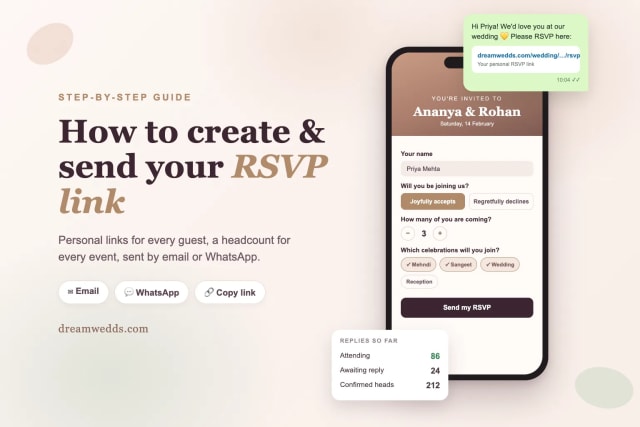
How to Create and Send an RSVP Link for Your Wedding (Step-by-Step)
8 NOV 2026
Tuscany vs Santorini vs Amalfi Coast for a wedding
18 JUN 2026

How Much Does a Destination Wedding in Europe Cost?
18 JUN 2026
Top 20 Wedding Destinations in Europe for a Fairytale Wedding
18 JUN 2026

Wedding Checklist for US Couples: What to Do and When
18 JUN 2026

Best Wedding Venues in the USA for Every Budget
18 JUN 2026
20 Most Popular Wedding Themes in America for 2026
18 JUN 2026

Average Wedding Cost in the USA: 2026 Budget Breakdown
18 JUN 2026

The Complete Wedding Planning Timeline for Busy Couples
18 JUN 2026
35 Unique Wedding Ideas That Wow Your Guests
18 JUN 2026
How to Create and Send an RSVP Link for Your Wedding (Step-by-Step)
8 NOV 2026
Tuscany vs Santorini vs Amalfi Coast for a wedding
18 JUN 2026
How Much Does a Destination Wedding in Europe Cost?
18 JUN 2026
Top 20 Wedding Destinations in Europe for a Fairytale Wedding
18 JUN 2026
Wedding Checklist for US Couples: What to Do and When
18 JUN 2026
Best Wedding Venues in the USA for Every Budget
18 JUN 2026
20 Most Popular Wedding Themes in America for 2026
18 JUN 2026
Average Wedding Cost in the USA: 2026 Budget Breakdown
18 JUN 2026
The Complete Wedding Planning Timeline for Busy Couples
18 JUN 2026
35 Unique Wedding Ideas That Wow Your Guests
18 JUN 2026
